Soccer Speed Development Guide for a 15-Year-Old Outside Defender
This article documents the training or athlete-development topic shown below as part of Alexis Burmeister's published soccer updates.
A 16-week plan for a 15-year-old soccer player to build acceleration, top speed, change of direction, strength, and game-speed confidence. The plan is especially useful for an outside defender or wide player who needs to close attackers, recover into the channel, overlap, win loose balls, and transition quickly after a turnover.

How to use this guide
This plan is designed to fit around team practice and matches. It is not meant to bury the athlete with more conditioning. Speed improves best when sprint reps are fast, fresh, technically clean, and followed by real recovery. Tired sprinting is conditioning; fast sprinting is speed training.
- Use the 16-week roadmap as the main plan. If the team schedule is heavy, use the in-season version with two speed sessions instead of three.
- Test at the start and every 4 weeks. Use the same shoes, surface, warm-up, and timing method.
- Keep a simple training log: what she did, best times, soreness, sleep, and confidence.
- Do not chase soreness. The goal is to get faster, not to feel destroyed.
Safety rules for a 15-year-old athlete
A teen athlete can benefit from strength, sprint, and plyometric training, but it has to be progressed carefully. Youth resistance training is most useful when programs are age-appropriate, supervised, technique-first, and progressed gradually.
- Pain rule: 0-2/10 mild discomfort can be monitored; 3/10 or higher, limping, swelling, sharp pain, or pain that changes stride means stop and get evaluated by a qualified clinician, athletic trainer, or physical therapist.
- Foot-specific warning: soreness or swelling in the pads or ball of the foot near the toes means remove jumping, sprint starts, and hard cutting until she can hop, jog, and change direction pain-free.
- Rest rule: keep at least one full rest day each week and protect the athlete from overtraining and burnout.
- Progress rule: increase only one variable at a time: sprint distance, number of reps, strength load, or plyometric intensity.
- Technique rule: every strength exercise should look controlled. Start light, build gradually, and avoid aggressive load jumps.
- Recovery rule: if sprint times slow down, legs feel heavy, or mechanics fall apart, stop the speed portion for the day.
What "faster" means in soccer
Soccer speed is not only a 40-yard dash. A player needs acceleration, top speed, braking, cutting, reaction, and the ability to repeat explosive actions without losing technique. Youth soccer involves frequent accelerations, decelerations, changes of direction, jumps, and sprints.
| Speed quality | What it looks like in a game | How this guide trains it |
|---|---|---|
| First-step quickness | Beating an opponent to a loose ball, closing down a winger, pressing after a turnover. | Short starts, falling starts, wall drills, 5-10 yd accelerations. |
| Acceleration | Building speed over 10-30 yards for recovery runs, overlaps, and runs into space. | 10/20/30 yd sprints, light resisted starts, hill or sled options if supervised. |
| Top speed | Long recovery runs, chasing a through ball, separating on a wide run. | Flying 10s/20s, sprint-float-sprint, relaxed max-velocity mechanics. |
| Deceleration | Stopping before a tackle, arriving under control, cutting without knee collapse. | Brake-to-stick drills, snap-downs, 5-10-5, plant-and-cut work. |
| Change of direction | Defending 1v1, reacting to a winger, turning with the play. | L-drills, T-drills, mirror drills, reactive cone calls. |
| Repeated speed | Still sprinting late in games after multiple high-intensity actions. | Small repeated sprint sets after a base of speed and strength is built. |
Baseline testing: start here before Week 1
Testing gives her a target and helps you know whether the plan is working. Use a phone stopwatch if that is all you have, but use the same person and method each time. Even better, film in slow motion from the side for mechanics and use timing gates if available.

| Test | Setup | How to do it | Record |
|---|---|---|---|
| 10 yd sprint | Start line and 10 yd cone. | Three reps from a two-point stance. Full rest between reps. | Best time and video notes. |
| 20 yd sprint | Start line and 20 yd cone. | Three reps. Focus on powerful first steps and smooth rise. | Best time. |
| Flying 20 | 20 yd build-in plus 20 yd timed zone. | Build gradually, sprint through the timed zone relaxed. | Best time; do not time the build-in. |
| 5-10-5 shuttle | Three cones: center, 5 yd left, 5 yd right. | Start at center. Touch one side, touch other side, finish center. | Best each direction. |
| Broad jump | Start behind line, jump forward, stick landing. | Three reps. Measure from line to back heel. | Best distance. |
| Wellness check | Before training. | Rate sleep, soreness, stress, and energy 1-5. | Use this to adjust volume. |
The weekly structure
The fastest work should happen when she is freshest. Sprinting after a hard team practice or the day after a match usually teaches tired mechanics. A good week alternates high-intensity speed/strength with soccer, mobility, and recovery.
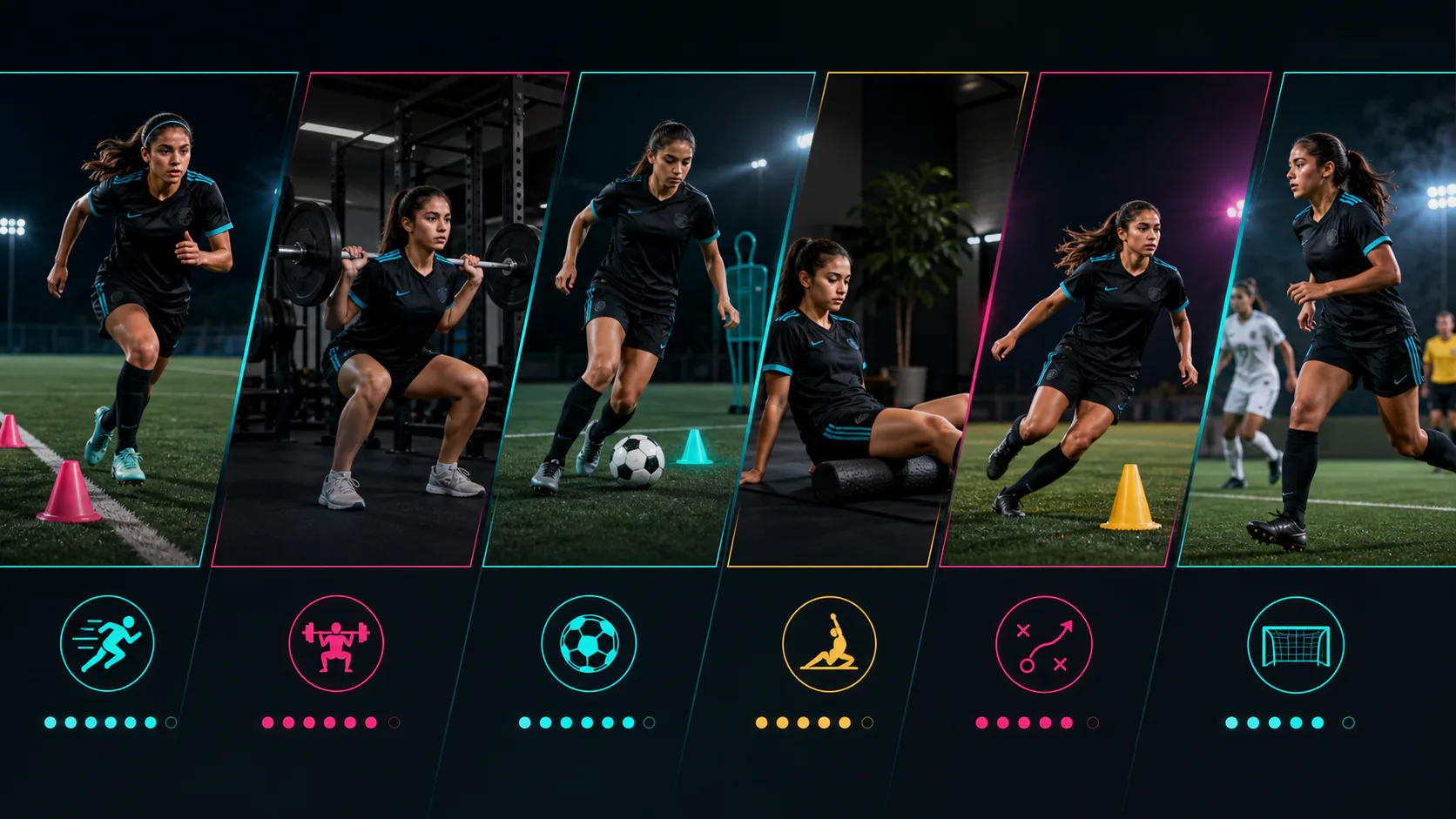
| Situation | Recommended setup |
|---|---|
| Off-season or light team schedule | 3 speed sessions, 2 strength sessions, 1-2 soccer technical sessions, 1 full rest day. |
| In-season or heavy team schedule | 2 speed micro-sessions, 1-2 short strength sessions, mobility/prehab, 1 full rest day. |
| Tournament week | Keep only a short warm-up speed primer early in the week. No heavy lower-body training within 48 hours of multiple games. |
| Sore/tired week | Cut sprint volume by 30-50%, remove plyometrics, keep mobility and easy technical touches. |
Warm-up system: prepare the body to sprint
Every speed session starts with a warm-up. A complete soccer warm-up should raise temperature, build mobility, activate key muscles, prepare sprint mechanics, and include a primer before the first full sprint.
| Warm-up block | Time | Exercises |
|---|---|---|
| Raise temperature | 3-5 min | Easy jog, shuffle, backpedal, side shuffle, carioca, skip. |
| Mobility | 4-5 min | Ankle rocks x10/side, leg swings x10/side, hip open/close x8/side, worlds greatest stretch x4/side. |
| Activation | 3-5 min | Glute bridge x10, dead bug x8/side, side plank 20 sec/side, calf pogos x20. |
| Sprint prep | 4-6 min | A-skip 2x15 yd, dribbles/ankling 2x15 yd, build-ups 3x20 yd at 60/70/80%. |
| Primer | 2-3 min | Two 10 yd starts at 85-90% before the first full sprint. |
Speed technique: acceleration
Acceleration is the first 5-30 yards. This is where a soccer player wins loose balls, starts an overlap, or closes down a player before they can lift their head. The goal is to push the ground down and back, keep the body line strong, and gradually rise into sprinting.
- Start posture: feet staggered, front shin angled forward, hips slightly above knees, chest proud, eyes down 2-3 yards ahead.
- First three steps: powerful and slightly longer each step; do not tap tiny steps in place.
- Arms: drive elbows straight back and forward. Fast arms help fast legs.
- Body angle: lean from the ankles. Do not bend at the waist or hunch the shoulders.
- Rest: short acceleration reps still need rest. Use 60-120 seconds between quality sprints.
Speed technique: max velocity
Top speed is not the same as acceleration. At max velocity she should look taller, bouncier, and more relaxed. The hips stay high, the foot contacts under the body, the shoulders stay relaxed, and the stride cycles quickly instead of reaching forward.
- Tall posture: head stacked over shoulders, ribs stacked over hips.
- Relaxed speed: face, hands, and shoulders relaxed; sprinting should not look tense.
- Foot contact: quick contact under the hips, not a reaching heel strike far out front.
- Full recovery: rest 2-3 minutes between flying sprints so every rep is fast.
Speed technique: deceleration and cutting
Fast players must have fast brakes. A defender who cannot slow down will overrun the play. Deceleration training teaches her to arrive under control, stay balanced, and re-accelerate in a new direction.
- Brake with multiple short steps before the cut instead of one huge reaching step.
- Lower the center of mass: hips back, knees bent, chest over knees.
- Knee position: knee tracks over toes. Avoid the knee collapsing inward.
- Plant foot: stable and under control before pushing into the new direction.
- Progression: first stick the stop, then add a planned cut, then add a reactive cue.
Field drill setups
Most speed work can be done with a small amount of field space and a few cones. The recurring setups are an acceleration lane, a flying sprint zone, a 5-10-5 shuttle, and an L-drill or T-drill pattern.
Strength training for speed
Strength gives the body the ability to put more force into the ground. For a teen athlete, this should be technique-first and supervised. The plan uses moderate loads, controlled reps, and no max-lifting.
| Movement pattern | Main exercises | Why it helps speed | Starting prescription |
|---|---|---|---|
| Squat / single-leg strength | Goblet squat, split squat, reverse lunge, step-up. | Improves leg strength and control for acceleration and landing. | 2-3 sets x 6-10 reps. Start bodyweight/light. |
| Hip hinge / posterior chain | RDL, single-leg RDL, kettlebell deadlift, hip thrust. | Builds glutes and hamstrings for sprint push-off. | 2-3 sets x 6-10 reps. |
| Hamstrings | Hamstring walkout, assisted Nordic, slider curl. | Supports sprinting and helps reduce hamstring strain risk when progressed carefully. | 2 sets x 3-6 controlled reps at first. |
| Calves/ankles/feet | Calf raise, eccentric calf lower, pogo, tibialis raise. | Improves ankle stiffness and lower-leg durability for repeated sprinting. | 2-3 sets x 10-15 reps. |
| Core/trunk | Dead bug, side plank, Pallof press, farmer carry. | Helps transfer force between upper and lower body while cutting and sprinting. | 2-3 sets, controlled. |
| Upper body | Push-up, row, medicine ball chest pass if supervised. | Arm drive and contact strength; overall athletic balance. | 2-3 sets x 6-12 reps. |
Plyometrics: jump training for power
Plyometrics are jumps, hops, bounds, and quick contacts that train the body to produce force quickly. Use them progressively and stop when landings are no longer quiet, aligned, and controlled.
| Level | When to use | Exercises | Volume guide |
|---|---|---|---|
| Level 1: landing and rhythm | Weeks 1-4 and any return from soreness. | Snap-down to stick, pogo hops, low squat jump, broad jump to stick. | 30-60 total contacts/week. |
| Level 2: power | Weeks 5-8 if Level 1 is clean. | Broad jump, box jump, lateral bound to stick, low hurdle hops. | 50-80 contacts/week. |
| Level 3: reactive power | Weeks 9-12 if no pain and form is excellent. | Lateral bound to sprint, repeated broad jump, single-leg pogo, hop-stick-cut. | 60-90 contacts/week, lower if team load is high. |
| Maintenance | Weeks 13-16 and in-season. | 2-4 high-quality jump exercises before sprint work. | 30-60 contacts/week. |
- Land quietly: soft knees, hips back, whole foot controlled, knee over toes.
- Stop plyometrics if landings get loud, knees cave, or foot/shin pain appears.
- Do plyometrics before heavy strength work or after the warm-up, not at the end of a fatigue session.
The 16-week plan
This plan assumes she has soccer practices and/or technical sessions during the week. When team load is high, reduce this plan rather than stacking everything. Each fourth week is a retest/deload week.

| Weeks | Main goal | Speed work | Strength + plyo emphasis | Retest/adjust |
|---|---|---|---|---|
| 1-4: Foundation | Clean mechanics, foot/ankle/calf tolerance, landing/braking basics. | 2-3 sessions/week: 10 yd starts, wall drills, relaxed build-ups, basic decel to stick. | Bodyweight/light strength 2x/week. Level 1 plyos only. | Week 4: retest 10 yd, 20 yd, broad jump, 5-10-5. Drop volume 25-40%. |
| 5-8: Build acceleration | More powerful first 10-20 yd; introduce flying sprints. | 3 sessions/week if fresh: acceleration day, flying sprint day, COD day. | Strength 2x/week. Level 2 plyos if landings are clean. | Week 8: retest. Keep only exercises that are improving her speed and confidence. |
| 9-12: Power + change of direction | Max velocity, reactive cutting, repeated explosive actions. | Acceleration + max velocity + reactive COD; add soccer-specific races. | Strength 2x/week with lower volume. Level 2-3 plyos as tolerated. | Week 12: retest and compare to baseline. Reduce any drill that causes soreness. |
| 13-16: Perform and transfer | Keep speed high while reducing fatigue. Transfer speed to game situations. | 2-3 short, high-quality sessions; more ball and game-speed transitions. | Strength 1-2x/week maintenance. Low-volume plyos. | Week 16: final test, then maintenance plan. |
Detailed session templates
Acceleration and First-Step Quickness
Purpose
Improve the first 5 to 30 yards used for overlaps, recovery runs, and closing wide attackers.
Setup
Use cones for 10-yard and 20-yard starts with full walk-back recovery.
Reps
6 to 10 total sprints after a dynamic warm-up
- Push the ground back on the first step.
- Keep the torso angled forward early.
- Drive the arms without tightening the shoulders.
- Stop the set when speed drops.
Progression: Add ball or chase cues after mechanics stay clean.
Regression: Use falling starts or wall-drive switches before sprint starts.
| Block | Drill | Prescription | Coaching cue |
|---|---|---|---|
| Warm-up | RAMP warm-up + sprint prep | 15-18 min | Warm, mobile, activated, and sharp before sprinting. |
| Mechanics | Wall drive switch or partner lean switch | 3 x 5/side | Push through the ground; hips tall; ribs down. |
| Start skill | Falling start or push-up start | 4 x 10 yd | Explode on first movement; do not pop up. |
| Main sprint | 2-point start | 4 x 20 yd | Powerful first 3 steps; full rest. |
| Soccer transfer | Loose-ball race or overlap sprint | 4 reps | Sprint through the ball/space, then control first touch. |
| Cool down | Walk, calves, hips, easy touches | 5-8 min | Leave feeling fast, not crushed. |
| Block | Drill | Prescription | Coaching cue |
|---|---|---|---|
| Warm-up | Dynamic warm-up + build-ups | 15-20 min | Build gradually to near-max speed. |
| Drills | A-skip, dribbles/ankling, wicket-style cone runs | 2 rounds | Tall posture; contact under body. |
| Main sprint | Flying 10 or flying 20 | 4-6 reps | Build in, sprint relaxed through zone, full 2-3 min rest. |
| Optional | Sprint-float-sprint | 3 reps of 20-20-20 yd | Fast, relax, fast again. |
| Soccer transfer | Long recovery run into controlled decel | 3-4 reps | Sprint fast, then arrive under control. |
| Block | Drill | Prescription | Coaching cue |
|---|---|---|---|
| Warm-up | Dynamic warm-up + decel prep | 15 min | Knees track over toes; land quietly. |
| Brake skill | 10 yd sprint to stick | 4 reps | Short braking steps; hips back. |
| Planned COD | 5-10-5 shuttle | 3 reps each direction | Touch line under control; re-accelerate hard. |
| Cornering | L-drill or T-drill | 3-4 reps | Turn hips and shoulders; exit fast. |
| Reactive | Mirror drill or coach cone call | 6 x 5-8 sec | React, stay low, do not cross feet unless turning. |
| Soccer transfer | 1v1 wide channel close-down | 4 reps | Close fast, brake, side-on jockey. |
| Exercise | Sets x reps | Notes |
|---|---|---|
| Goblet squat | 3 x 8 | Controlled depth. Knees track over toes. |
| Romanian deadlift | 3 x 8 | Hips back, neutral spine, hamstrings loaded. |
| Rear-foot-elevated split squat or reverse lunge | 2-3 x 6-8/side | Start bodyweight if needed. |
| Hip thrust or glute bridge | 3 x 10 | Pause at the top; ribs down. |
| Standing calf raise | 3 x 12 | Full range, slow lower. |
| Side plank | 2 x 25-40 sec/side | Straight line head to heels. |
| Exercise | Sets x reps | Notes |
|---|---|---|
| Trap-bar deadlift, kettlebell deadlift, or bodyweight hinge | 3 x 5-6 | Only if supervised and technique is excellent. |
| Step-up | 3 x 6/side | Drive through whole foot; control down. |
| Single-leg RDL | 2-3 x 6/side | Balance and hip control. |
| Assisted Nordic or hamstring walkout | 2 x 3-6 | Partial range is fine. Never force the descent. |
| Tibialis raise | 2 x 15 | Helps lower-leg balance. |
| Pallof press or dead bug | 2-3 x 8-10/side | Anti-rotation control. |
Monthly detail: what each week should look like
| Week | Focus | Key work | Volume |
|---|---|---|---|
| 1 | Baseline + clean starts | Test, learn warm-up, 6-8 short accelerations/session | Low |
| 2 | Acceleration rhythm | Add wall drill, falling starts, 10-20 yd sprints | Low-moderate |
| 3 | Braking basics | Add 10 yd decel-to-stick and Level 1 plyos | Moderate |
| 4 | Deload + retest | Cut volume, retest, review video | Low |
| 5 | Acceleration power | 2-point starts, 20 yd sprints, light resisted option | Moderate |
| 6 | Introduce flying speed | Flying 10s, tall posture, longer rest | Moderate |
| 7 | COD build | 5-10-5, L-drill, lateral bounds | Moderate |
| 8 | Deload + retest | Cut volume, retest, adjust plan | Low |
| 9 | Top speed quality | Flying 20s, sprint-float-sprint | Moderate |
| 10 | Repeated acceleration | Small repeated sprint clusters with full technique | Moderate-high |
| 11 | Reactive COD | Mirror drill, cone calls, 1v1 channels | Moderate |
| 12 | Deload + retest | Retest and compare to baseline | Low |
| 13 | Game transfer | Overlap/recovery runs, sprint-to-touch, close-down drills | Moderate |
| 14 | Speed maintenance | Short high-quality sprint doses, reduced lifting volume | Moderate |
| 15 | Confidence week | Fast reps only, stop before fatigue | Low-moderate |
| 16 | Final test + maintenance | Final test, then transition to maintenance plan | Low |
Outside defender / wide player speed transfer
For an outside defender, speed is not just a race. It is sprinting, scanning, stopping, angling the body, and playing the next touch. Add one soccer-specific transfer block after the main speed work, but keep the reps crisp.

| Game action | Drill | Prescription | Coaching cue |
|---|---|---|---|
| Close down a winger | Start 12-15 yd away. Sprint to cone, brake, side-on jockey 3 sec. | 4-6 reps. | Arrive fast but under control. Do not fly past the attacker. |
| Recovery into wide channel | Start central, drop-step, sprint diagonally 20-30 yd, decel to turn. | 4 reps each side. | First step opens hips; sprint line cuts off space. |
| Overlap run | Pass inside, overlap 25-35 yd, receive ball in stride. | 4-6 reps. | First touch forward without breaking stride. |
| Transition after turnover | Coach points or calls color. Player reacts and sprints to target cone/ball. | 6-8 reps of 5-12 sec. | React before sprinting. Scan first. |
| Defend and counter | Backpedal 5 yd, turn, sprint 20 yd, receive ball and pass/cross. | 4 reps. | Clean hip turn; first touch sets the next action. |
Recovery, sleep, hydration, and food
Adaptation happens after training. A player who sleeps, eats, hydrates, and recovers well will usually improve faster than a player who simply adds more workouts. Daily activity still matters, but every day should not be a hard sprint day.
| Area | Target | Practical actions |
|---|---|---|
| Sleep | Consistent, sufficient sleep for recovery and school performance. | Regular bedtime, phone away, dark/cool room, no late caffeine. |
| Hydration | Start training and games well hydrated. | Use urine color as a simple check. Bring water to training. Add electrolytes/carbs during longer or hot sessions. |
| Fuel before training | Carbs + fluid 1-3 hours before. | Examples: bagel + peanut butter, yogurt + granola, banana + toast, rice/chicken if more time. |
| Fuel after training | Carbs + protein within a normal meal/snack window. | Examples: chocolate milk + sandwich, rice bowl, eggs + toast, smoothie + protein food. |
| Growth support | Do not under-eat to get faster. | Teen athletes need energy for training and growth. Prioritize regular meals, calcium/vitamin D foods, iron-rich foods, and protein. |
U.S. Soccer Recognize to Recover notes that dehydration can affect both endurance and skill performance and recommends that players start training and games well hydrated, while avoiding excessive water intake. For sessions over an hour, especially in heat, fluid losses should generally stay within about 2% of starting body weight.
Mobility and prehab mini-routine
This 10-12 minute routine can be done after training, before bed, or on recovery days. It should feel good, not painful.
| Area | Exercise | Dose |
|---|---|---|
| Ankles/calves | Knee-to-wall ankle rocks + calf stretch | 10 rocks/side + 30 sec stretch/side |
| Hip flexors | Half-kneeling hip flexor stretch | 30 sec/side |
| Glutes/hips | 90/90 switches or figure-4 stretch | 8 switches or 30 sec/side |
| Hamstrings | Hamstring floss or light hinge | 8-10 controlled reps |
| Adductors | Rock-back adductor stretch | 8 reps/side |
| Core reset | Dead bug breathing | 6 slow breaths/side |
How to adjust the plan
| Signal | What it means | Adjustment |
|---|---|---|
| Times improving and she feels springy | Plan is working. | Continue. Add only small volume or intensity changes. |
| Times flat but body feels good | May need more rest or more quality. | Reduce junk volume; increase rest between sprints; keep strength moderate. |
| Times worse by 3%+ and legs feel heavy | Fatigue is winning. | Stop speed work for the day or cut volume 50%. Prioritize sleep and recovery. |
| Foot/shin/Achilles pain | Lower-leg load is too high or mechanics/surface are an issue. | Remove plyos and hard cuts. Use bike/upper/core. Return gradually when pain-free. |
| Knees cave during landings/cuts | Movement control needs more work. | Return to Level 1 landings, side planks, split squats, and coach feedback. |
| Busy tournament week | High external load. | No heavy lifting or extra conditioning. Use warm-up, mobility, and a few short primers only. |
Parent/coach support checklist
- Time her reps, but do not turn every session into pressure. Praise effort, technique, and consistency.
- Film from the side for acceleration and from the front for cutting/landing mechanics.
- Protect rest days. Teen athletes often need help saying no to extra work when they are tired.
- Keep the main goal simple: better first step, better top speed mechanics, safer brakes, stronger body, more confidence.
- Communicate with her coach if the team training load is high so the extra plan does not overload her.
Quick-start version for the first two weeks
If you want to start without overthinking, use this two-week starter plan. Then move into the full 16-week plan.
| Day | Week 1 | Week 2 |
|---|---|---|
| Mon | Acceleration Session A at low volume + Strength A light. | Acceleration Session A + Strength A. |
| Tue | Team practice or technical touches + mobility. | Team practice or technical touches + mobility. |
| Wed | Max velocity mechanics: build-ups only + core. | Max velocity Session B, 4 flying reps only. |
| Thu | Team practice or recovery. | Team practice or recovery. |
| Fri | COD basics: decel-to-stick + Strength B light. | COD Session C low volume + Strength B. |
| Sat | Match/scrimmage/technical work. | Match/scrimmage/technical work. |
| Sun | Full rest. | Full rest. |
Maintenance plan after 16 weeks
Once she has built speed, she can maintain it with less work. The maintenance goal is to touch high speed every week without creating fatigue that hurts soccer.
| Day type | Minimum effective dose |
|---|---|
| Speed primer 1 | Warm-up + 4 x 10 yd + 3 x 20 yd + 3 broad jumps. |
| Speed primer 2 | Warm-up + 3-5 flying 10s/20s with full rest. |
| Strength | 1-2 sessions/week: squat/lunge, hinge, hamstring, calf, core, upper body. |
| COD/prehab | 5-10 min of decel, side plank, calf/tibialis, and hip mobility after warm-up. |
Sources
These sources informed the safety guidelines, warm-up recommendations, youth resistance training principles, hydration guidance, and programming choices in this guide. The workouts are practical coaching applications and should be adjusted to the athlete maturity, training history, soccer schedule, soreness, and medical status.
- FIFA - injury prevention and health promotion.
- FIFA 11+ Manual - complete warm-up programme to prevent injuries.
- Faigenbaum et al. - Youth resistance training: updated position statement paper from the NSCA.
- American Academy of Pediatrics - Strength Training patient education handout.
- HealthyChildren.org / AAP - Preventing Overuse Injuries in Young Athletes.
- CDC - Physical Activity Guidelines for School-Aged Children and Adolescents.
- U.S. Soccer Recognize to Recover - Nutrition & Hydration.
- Luo et al. 2025 - Strength and plyometric training in female adolescent team sport athletes.
- Thapa et al. 2021 - Complex training effects on sprint, jump, and change of direction in soccer players.
- Michailidis et al. 2023 - Combined horizontal plyometric and change of direction training in youth soccer players.
Appendix: generated poster image
The generated images in this article are visual companions to the guide. Use the written plan above as the source of truth for exact workouts, safety rules, and progressions.